Count from the first shofar blast to the last pumpkin at Brooklyn Bridge Park and you get thirty-five days. That is the stretch this year between Rosh Hashanah's second day, on September 13, and the park's Harvest Festival on October 17. In most neighborhoods, fall arrives as a mood: cooler air, a few sweaters, maybe a pumpkin display outside a bodega. In Brooklyn Heights, it arrives as a schedule, and this year's schedule is unusually stacked, because four of the neighborhood's oldest institutions all happen to be running their biggest annual moments inside the same five and a half weeks.
The Brooklyn Heights Association has been sending its members a newsletter titled some version of "Fall Events" before Labor Day for years now, a habit that says something true about how this particular neighborhood keeps time. It isn't waiting for the equinox. It's waiting for the calendar to clear enough congregational, civic, and commercial commitments to fit everyone in.
What's actually stacked on top of what
Here's the density, laid out the way a resident would actually experience it rather than the way a press release would:
| Date | What's happening | Who's running it |
|---|---|---|
| Sept 11 (Fri, sundown) | Rosh Hashanah begins | Neighborhood congregations |
| Sept 13 (Sun) | Second-day shofar, widely observed since day one fell on Shabbat | Congregations citywide |
| Sept 13 (Sun), noon–4pm | Back-to-School Open Streets Party, car-free Montague from Clinton to Hicks | Montague Street BID, BHA, NYC DOT |
| Sept 13 (Sun), 2–4pm | Public tashlich at Brooklyn Bridge Park | The Neighborhood with Romemu Brooklyn |
| Sept 20–21 | Yom Kippur | Neighborhood congregations |
| Sept 25 (Fri) | Shabbat dinner in the sukkah | Brooklyn Heights Synagogue |
| Sept 26 (Sat) | Brooklyn Book Festival | Downtown Brooklyn |
| Sept 27 (Sun) | Atlantic Antic street fair, Brooklyn Heights through Boerum Hill | Atlantic Avenue merchants and neighborhood groups |
| Sept 27 (Sun), 9:30am | Sunday in the Sukkah | Brooklyn Heights Synagogue |
| Sept 30 (Wed) | Designer Showhouse Opening Night | Brooklyn Heights Association |
| Oct 2–Nov 1 | Showhouse public hours at One Monroe Place | Brooklyn Heights Association |
| Oct 3 (Sat) | Simchat Torah pizza block party | Brooklyn Heights Synagogue |
| Oct 17 (Sat) | Harvest Festival | Brooklyn Bridge Park |
Two of those dates are worth sitting with. September 13 carries a car-free block party for families on Montague at the exact same hour that congregations across the borough are blowing the shofar for the first time this year, because the actual first day of Rosh Hashanah fell on Shabbat and the ritual doesn't happen on Shabbat. And September 27 carries both a sukkah open house at 9:30 in the morning and, later that day, ten blocks of Atlantic Avenue closing to traffic for one of the city's oldest street fairs. None of this was coordinated. It's what happens when a neighborhood this size has this many institutions with this much history, all trying to hold their signature event in the six weeks between the end of summer and the start of the holidays.
The mansion that almost wasn't there
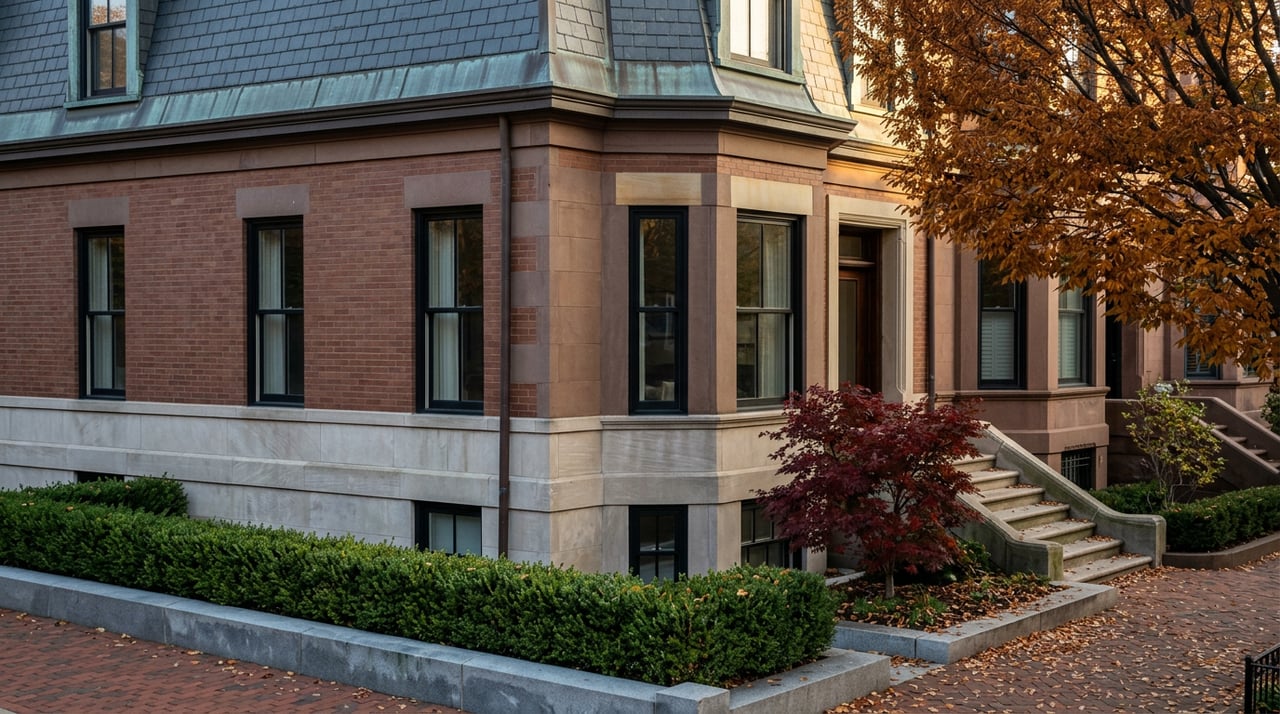
The single biggest draw of the stretch is also the one with the strangest backstory. The Brooklyn Heights Designer Showhouse, the Association's main annual fundraiser, opens to the public October 2 inside One Monroe Place, also known as 100 Clark Street, a landmarked 1852 corner mansion that spent years as a cautionary tale before it became a showpiece. The building was originally built in the Greek Revival style for a merchant named Samuel Bell, then took on its distinctive mansard roof in the 1860s. By the 1890s it belonged to the Weirs, the Brooklyn Heights family behind the James Weir Floral Company, a business that has been in continuous operation on Montague Street since 1853, meaning the flower shop has now outlasted several distinct eras of the very mansion the family once called home. A 1950 Certificate of Occupancy shows the building carved into three apartments per floor. Then, in May 2008, the top floors were demolished outright.
What followed was a ten-year gut restoration that BHA Executive Director Lara Birnback described directly: "so many of us watched the near destruction and then resurrection of this special house." The result is a 9,525-square-foot residence with nine bedrooms, seven baths, and a rooftop terrace, set up to eventually hold one family on the upper floors and two studios at garden level. Seventeen designers and architects, from Studio Olivine to Sugarhouse Design & Architecture, have been assigned rooms for what organizers are calling the Showhouse's most ambitious build yet, a real claim given that past editions worked with an 1860s brownstone, an 1820s wood frame house, an 1830s townhouse, and an 1840s row house. None of those approached 9,500 square feet.
The Showhouse only happens every other year, and it exists because BHA, founded in 1910 and the oldest neighborhood association in New York City, needs a way to fund the advocacy and preservation work it does the rest of the time. Buying a ticket to walk through a stranger's rebuilt mansion is, in a roundabout way, how this particular civic group keeps its lights on.
The weekend that doesn't let you choose one thing
If the Showhouse is the anchor, the last weekend of September is the crunch point. Saturday the 26th is the Brooklyn Book Festival in Downtown Brooklyn, a short walk from the neighborhood. Sunday the 27th is Atlantic Antic, which runs food, vendors, and live music across roughly ten blocks of Atlantic Avenue stretching from Brooklyn Heights into Boerum Hill, one of the borough's oldest street fairs. That same Sunday morning, Brooklyn Heights Synagogue is hosting Sunday in the Sukkah at 9:30. By the time Simchat Torah arrives on October 3, the same synagogue is closing out the run with a pizza block party, service, and dancing.
None of this is new information delivered as a novelty. It's the normal texture of the neighborhood's calendar, but this particular year has more of it landing in less time than usual, mostly because the Showhouse's biennial cycle and the Jewish calendar's own drift happened to line up with each other in late September 2026.
What holds steady underneath all of it
Not everything in this stretch is a special occasion, and that's arguably the more useful thing to know if you actually live here. The Brooklyn Borough Hall Greenmarket at Court and Montague has connected local farms to Brooklyn Heights and Downtown Brooklyn since 1983, and it runs every Tuesday and Saturday, year-round, straight through all thirty-five days of the above without pausing for any of it. The Tuesday market moves at the pace of the workday and school pickup. Saturday is slower, the kind of morning where people are loading up for the week rather than passing through. It doesn't have a headline moment or a ticketed opening night. It's just there, which during a stretch this loaded turns out to be its own kind of value.
The Harvest Festival on October 17 closes the run at Brooklyn Bridge Park with pumpkins and live music across the waterfront, the same park that hosted a kid-focused Family Film Night on Pier 1 back on September 18 and the tashlich gathering on the 13th. By the time the festival wraps, the neighborhood will have moved through two High Holidays, one street fair, one book festival, one month-long Showhouse, and a farmers market that never noticed any of it happening.
That's the actual story of fall here. It isn't one event worth clearing your Saturday for. It's thirty-five days where an unusual number of century-old institutions, from a 116-year-old civic association to a floral shop that has outlasted the mansion it started in, all decided to show up in the same five and a half weeks, and a neighborhood market that's been running since 1983 keeps the lights on underneath all of it.
If you're already living through this stretch and want to talk about anything else happening in Brooklyn Heights real estate this fall, from the market itself to the year-end pace, reach out to Jarrod Duncan. Let's Connect.